How to make a remarkable Seattle to Mt Rainier day trip — all the best information.
A lifelong local’s guide to the Seattle to Mt. Rainier day trip — when to go, where to stop, and how to slow down enough to actually feel it instead of rushing through.
As one of the earliest National Parks in the US, Mt. Rainier is a true standout. It’s not just a mountain but an emblem that adorns Washington’s license plate and dominates the horizon from both sides of the Cascade Mountains. Its unique features, such as the lakes, waterfalls, wildflowers, and pristine forests, make it a nature lover’s paradise.
Avoid the “meh” of day trip madness and plan the best possible drive from Seattle to Mt. Rainier National Park.
- Best if you’re visiting Mt. Rainier National Park with limited time.
- Great for newcomers to the Pacific Northwest.
- Essential for hosting out-of-town guests.
- How to skip the crowds and find the quiet corners.
Most visitors plan way too much and end up burned out. A frenetic rush defeats the purpose of experiencing the magical essence of Mt. Rainier National Park. Use the information in this article to plan the best possible journey.
I’m an Airbnb superhost in Seattle, having hosted thousands of guests over the last ten years. As you might imagine, many of my visitors want to go from Seattle to Mt. Rainier National Park. They typically allocate only one full day to this and — despite my recommendations — return dead tired, unimpressed by a whirlwind journey.
It’s part of our culture’s psyche to want to see it all. But, trust me — please don’t let this happen to your experience!
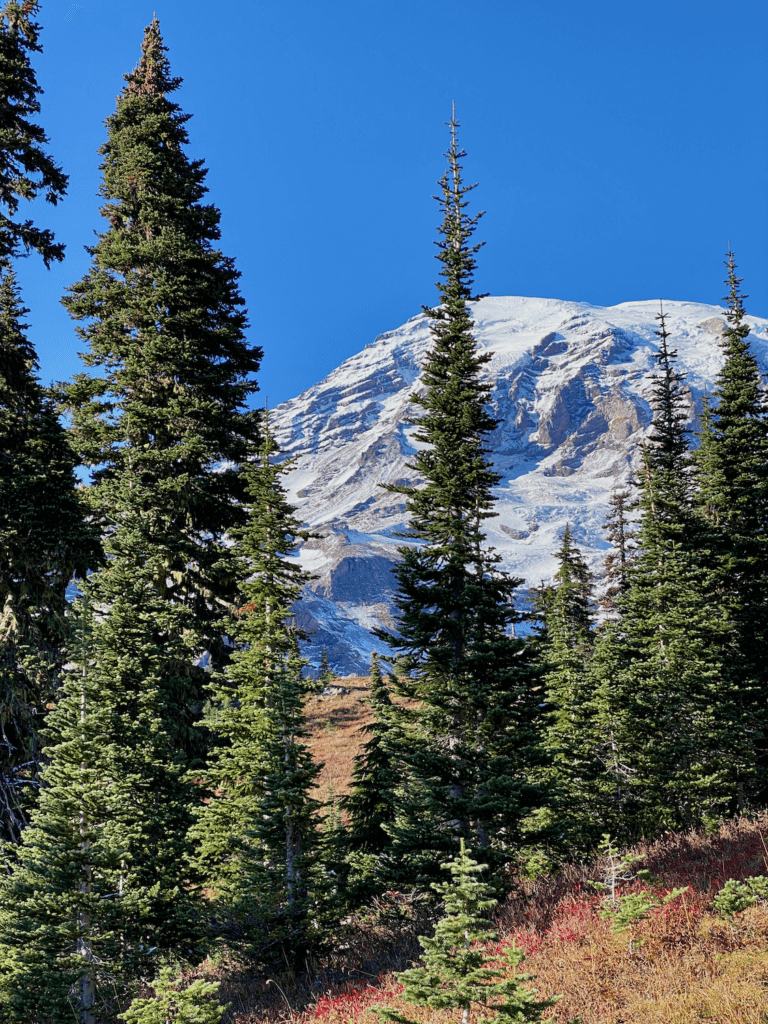
Table of Contents: After reading this article, you’ll be confident in the key priorities for a remarkable Seattle to Mt. Rainier experience.
- How to add Mt. Rainier to an extended itinerary.
- Mt. Rainier vs. North Cascades National Park.
- How long does it take to drive to Mt. Rainier?
- Portland to Mt. Rainier drive.
- When is the best time to go to Mt. Rainier?
- What to bring on a Mt. Rainier road trip?
- Forest Bathing on Mt. Rainier.
- How to plan the best day trip to Mt. Rainier.
- Nisqually Entrance to Mt. Rainier National Park.
- Mt. Rainier waterfalls and viewpoints.
- Paradise Mt Rainier
- Ohanapecosh and Stevens Canyon Entrance.
- Sunrise Visitor Center
Suppose you want to add Mt. Rainier National Park to a more extensive Pacific Northwest itinerary? You’ve come to the right place.
As a lifelong Oregon & Washington State local and former travel industry professional, I know how to get around the Pacific Northwest. I wrote an article about how to get to Portland from Seattle (and vice versa) and an even more specific post about the train between Seattle and Portland. I also offer an excellent itinerary for the Seattle to Portland drive.
Since many of you may be transiting to and from beautiful British Columbia in Canada, check out two articles about how to train from Seattle to Vancouver and the Seattle to Vancouver drive, which has my very comprehensive map of things to do; see, and eat between the two metro areas.
Seattle is also a great jumping-off point for exploring the beautiful wilderness of Olympic National Park. Access my article, How to Plan an Epic Olympic Peninsula road trip, for all the details. Finally, for another epic experience in mountain grandeur, try Seattle to North Cascades National Park.

There’s a deeper way to travel — and to live.
The same practice that turns a rushed day at Rainier into a remarkable one works anywhere — your own backyard, a city park, the middle of a hard week. That’s what my book, The Wild Cure, is about: six simple questions that bring you back into relationship with the Natural World.
Read it in a weekend, or listen while you walk. And if something in you says yes, book a free Nature Alignment Call and we’ll explore it together..
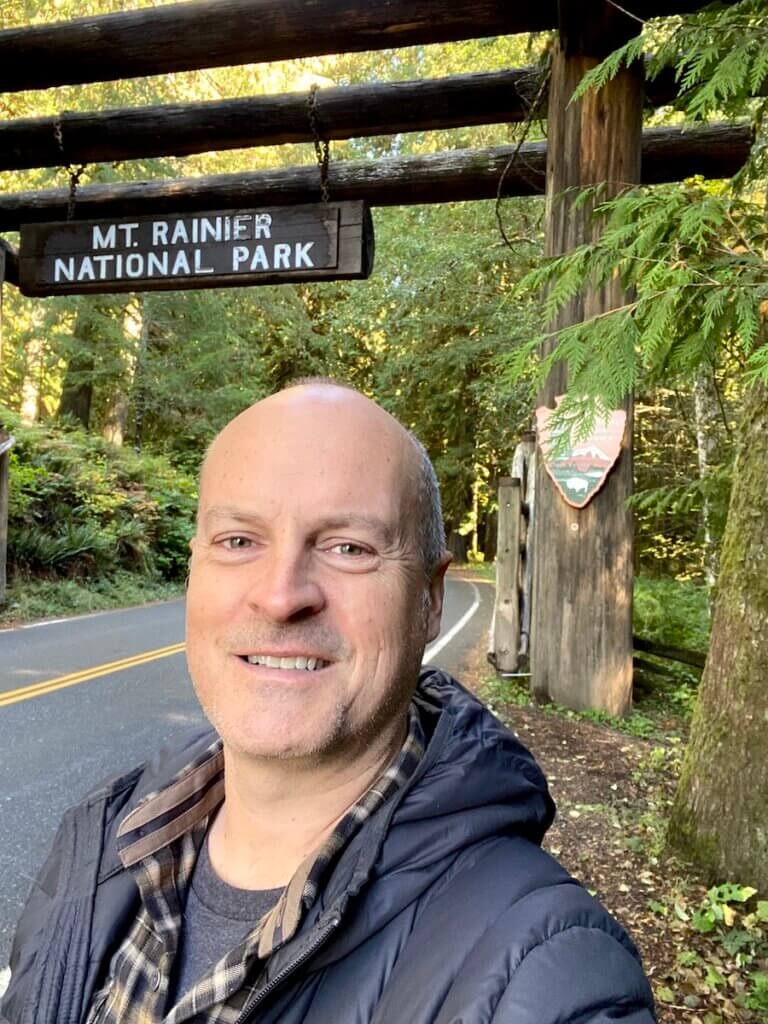
Why should you listen to Matthew Kessi (that’s me)?
- The Pacific Northwest is my lifelong playground.
- As a former travel industry professional, my experience guiding people around Oregon and Washington State gives me valuable insight into the right balance between what is possible and rewarding.
- Unlike big travel websites, I’ve been to all the places, tested the ideas, eaten the food, and taken photos. Unless specified, I don’t receive compensation for naming specific locations — my recommendations come from the heart.
- Since I live in Seattle, I visit the Cascade Mountains frequently to keep my knowledge updated.
- I’m a practical mystic, which means I actively integrate spiritual sensitivities and meaningful applications in daily life. I can help you find more rewarding experiences grounded in nature — and you can be more present to yourself, your companions, and all the wonders of travel. In another article, “Six steps to deepen your nature connection, “ I write about the fundamentals to do this.
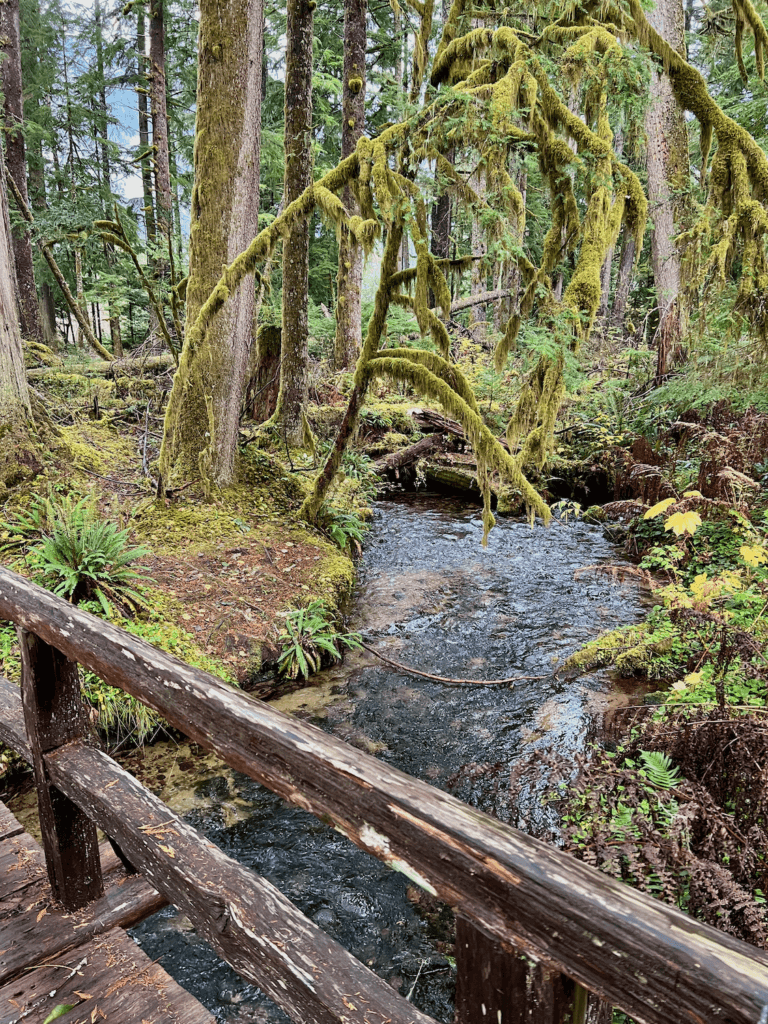
Join me on a Mt. Rainier 20 Minute Guided Nature Connection YouTube video.
Quiet your mind, open your heart, and allow your intuition to flow by following this Guided Nature Connection experience in the secret corner of Mt. Rainier National Park.
In this episode we reflect on ways that Nature’s Intelligence can help us shine through the nervous energy ups and downs of daily life? This is a path to get out of your head and into your own nature!
For a more simple Nature Meditation, also in the rainforest of Mt. Rainier, visit this YouTube video.
Mt. Rainier National Park vs North Cascades National Park — which is better?
“Ascending to 14,410 feet above sea level, Mount Rainier stands as an icon in the Washington landscape. An active volcano, it is the most glaciated peak in the contiguous U.S.A. and spawns five major rivers. Subalpine wildflower meadows ring the icy volcano, while ancient forest cloaks Mount Rainier’s lower slopes. Wildlife abounds in the park’s ecosystems. A lifetime of discovery awaits.”
National Park Service
While Mt. Rainier is an unparalleled alpine experience in Washington State, North Cascades National Park offers similar stunning natural features with a more wild and recreational vibe. A few things make the drive from Seattle to North Cascades National Park a more convenient choice:
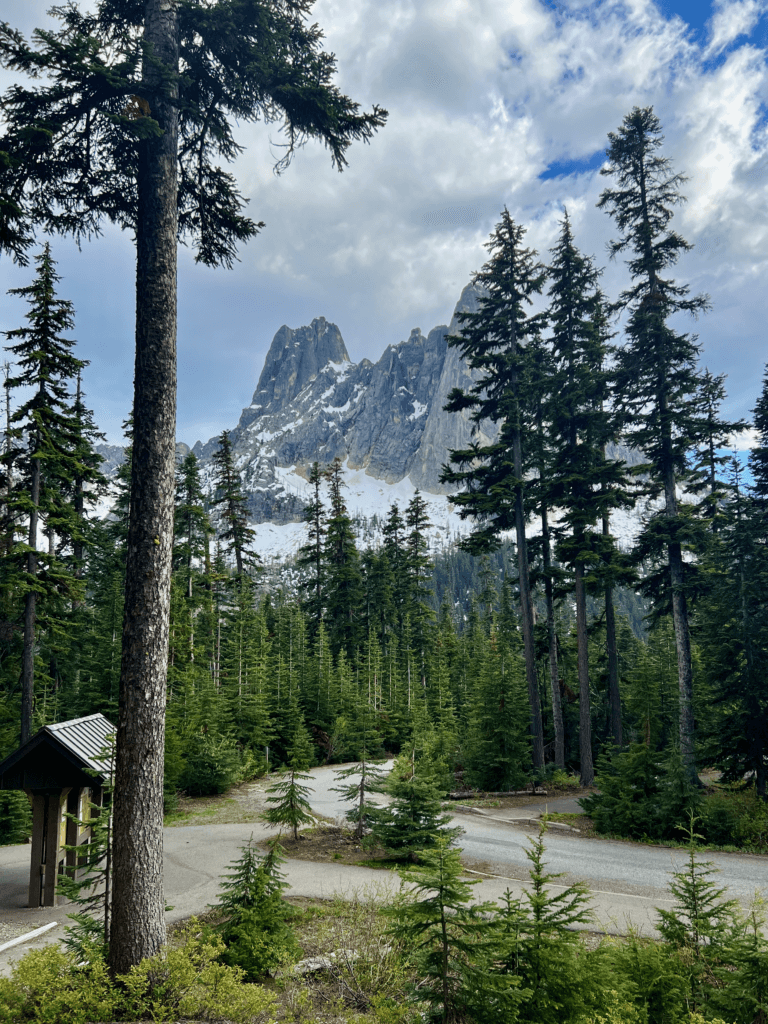
- North Cascades National Park (photo shown) is wilder and less crowded — great for a spontaneous trip.
- Seattle to North Cascades National Park is the same distance as Mt. Rainier (3 hours driving) but with fewer visitors.
- North Cascades National Park does not require paid admission.
- The loop route allows you to incorporate several other iconic Washington areas, such as Winthrop, Leavenworth, and Snoqualmie Falls, into a (very long) day trip from Seattle. But great for an overnight getaway along the way.
- Traffic is less complicated if you depart from Seattle and locations north, like Everett, Anacortes (San Juan Islands), or Bellingham.
- Pets are allowed on a leash in the Ross Lake National Recreation Area (the primary road trip stopping point).
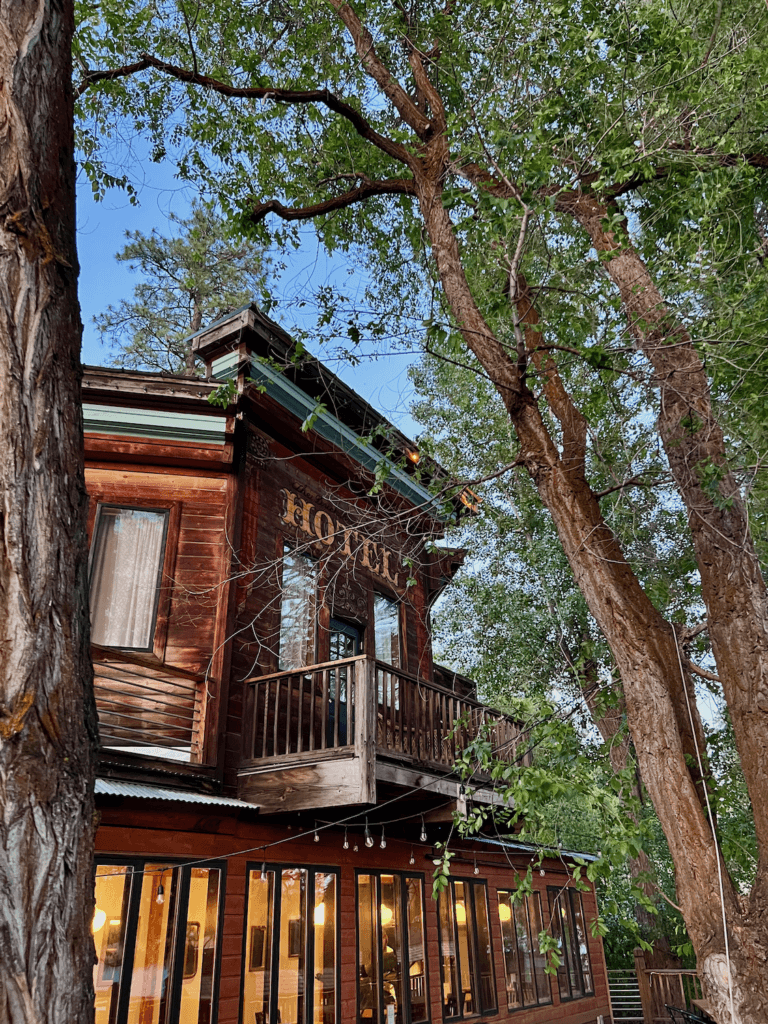
But what about places to stay?
While North Cascades National Park has fewer food and lodging services than Mt. Rainier, Rockport and Marblemount are good places to start for Airbnb rentals. Winthrop (on the other side of the Cascade Mountains) is a fun overnight location with many charming options.
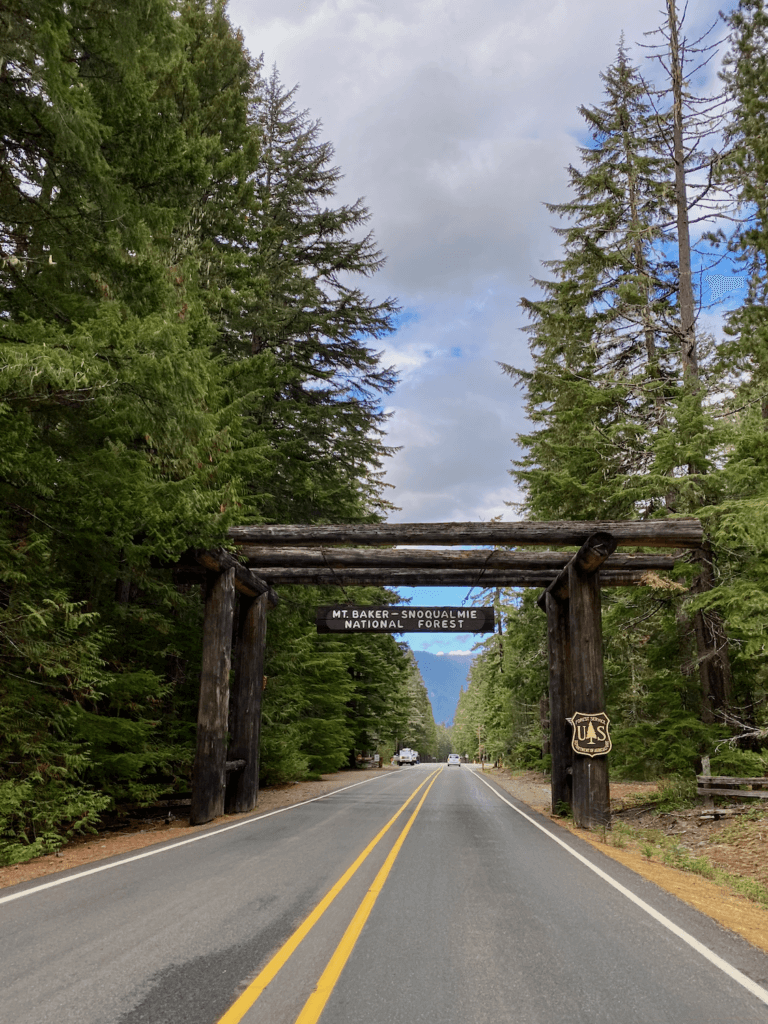
Getting started: Planning your visit from Seattle to Mt. Rainier
The first step in planning your experience visiting “the mountain”—as locals call it—is to assess the amount of time you have to spend. It’s not worth the effort without a full day available — as in 12 hours from Seattle.
Yes, it’s possible to rush up and back in a tighter day trip. But remember when I talked about my Airbnb guests who, against my recommendations, returned burnt out and underwhelmed about the experience.
Many people underestimate the time it takes to savor the unique alpine ecosystem, especially to enjoy a remarkable experience. They also grossly miss traffic estimations and one-hour delays at the park’s entrance during peak hours.
How long should you allow driving from Seattle to Mt. Rainier National Park?
Getting to and from Mt. Rainier National Park always takes longer than expected. Allow at least an extra hour for driving in each direction. Then, use this extra time, if available, to steep in your peaceful nature connection.
I plan the trip from Seattle to Mt. Rainier (Paradise or Sunrise) to be around four hours each way (map services will likely say three), and the journey from Tacoma is three hours (map services will say two). This depends on traffic — leave as early as possible in the morning or depart after rush hour and stay overnight near the entrance to the park.
If you’re visiting en route from Portland (see the next section), plan for around three hours each way, and Yakima, Washington (on the east side of the Cascades Mountains), is about two hours each way.
How to visit Mt. Rainier without your own vehicle.
If you prefer to leave the driving to someone else, consider one of many guided excursions to Mt. Rainier. There are many options and price points for your travel budget. But please still consider how much time you’ll spend on the mountain and how rushed the itinerary feels before deciding.
Portland to Mt. Rainier drive — and on to Seattle. Is it worth it?
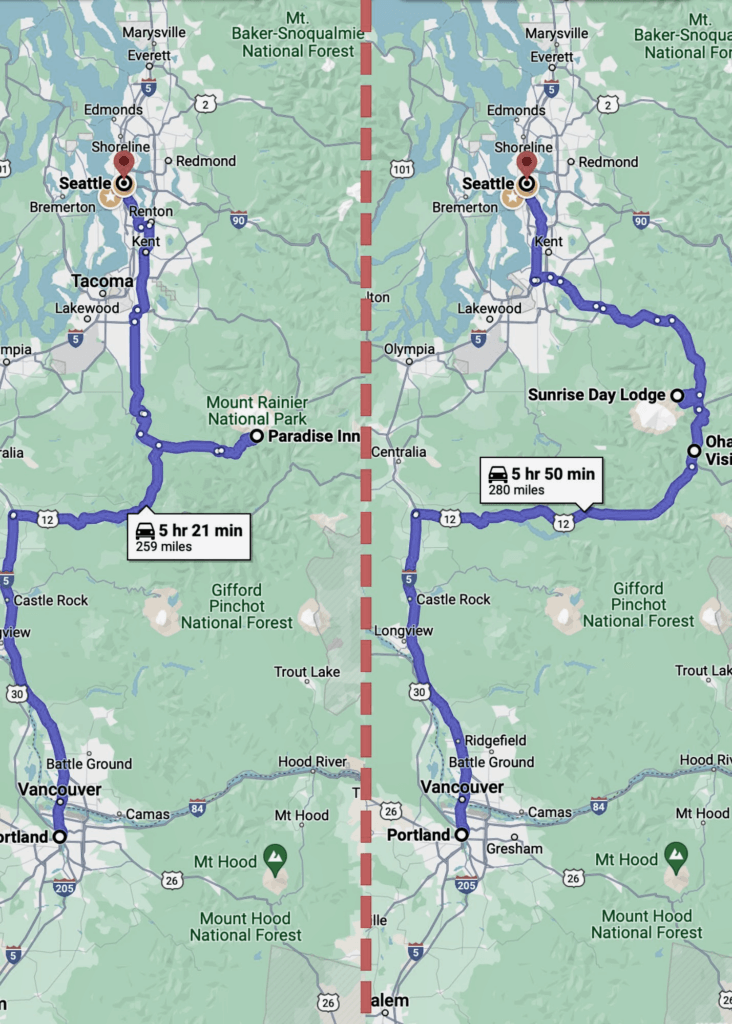
Looking at the map, it might seem like an easy stop along the way, but be careful with this plan because you can quickly burn out — and spend a lot of time in traffic. Here are the key planning considerations for Portland to Mt. Rainier when marking the drive between Seattle and Portland.
- Leave early (like before 7am) when traffic is in your favor.
- Choose between Paradise and Sunrise.
- Make only a few stops and spend quality time at each.
- Avoid driving in the Seattle/Tacoma area between 3-7 pm.
Northbound (Portland to Mt. Rainier)
I like the Sunrise Corridor for Portland to Mt. Rainier drives because there are plenty of great experiences along the way.
Packwood and Enumclaw provide plenty of meals, gas, etc., services to bookend the Portland to Mt. Rainier drive.
Southbound (Mt. Rainier to Portland)
I recommend the Paradise Corridor for drives from Seattle to Mt. Rainier, and then Portland.
Leaving early gets you through the thickest traffic liabilities. Then, you can spend time on the mountain and loop through the Ohanapecosh area (one of my favorite park areas) to Packwood for a bite or continue to Portland on mostly country back roads until you reach Interstate 5.
Add an overnight on the Portland to Mt. Rainier adventure.
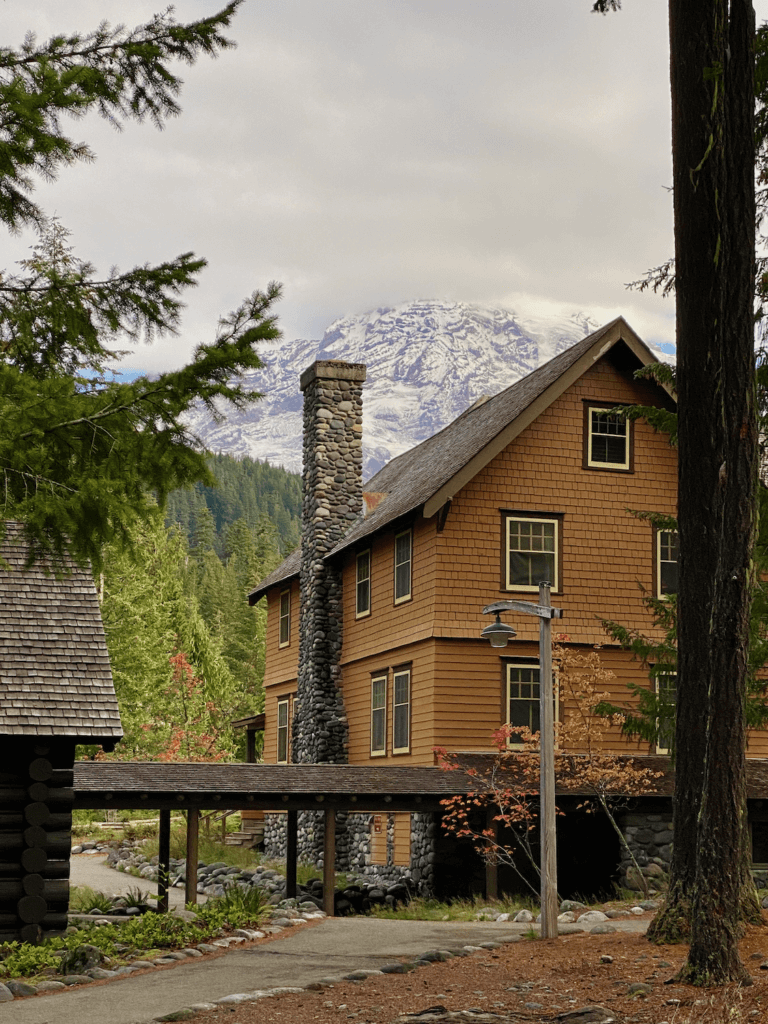
An ideal scenario is to add at least one overnight to the Portland to Mt. Rainier experience while traveling between Seattle and Portland. Besides the quintessential mountain experience of staying at Paradise Inn (which is hard to get into), consider places in National Park Inn (photo shown), Ashford, Packwood, or around Crystal Mountain.
The significant benefit of this decision is the ability to get into Mt. Rainier National Park early in the morning and/or experience the exquisite evening light before sunset the night before.
When to drive from Seattle to Mt. Rainier National Park.
For best results, try to go mid-week, and as early in the day as possible. As you might imagine, the visitors swell on weekends. Showing up before 7 am or after 3 pm also means thinner crowds and softer light.
Being a primarily alpine-focused experience, the summer season provides the best weather conditions for a road trip–and the wildflowers are beautiful in July and August.
Because most of the park is at higher altitudes, a large portion of Mt. Rainier National Park is closed during the winter due to snow. Check the road conditions if traveling from October through May.
If you’re interested in winter activities on Mt. Rainier, visit the NPS website for more information.
The June experience: While the lower elevations come alive with plenty of ways to enjoy nature (and spectacular views), there can still be a lot of snow at the timberline level. Paradise, in particular, is known for copious amounts of snowfall annually. Many of the trails are snowy or slushy–requiring snowshoes, determination, or excellent balance! If you brave the trails, please avoid getting off course and trample the budding flora.
Most alpine services open at the end of June or early July. Depending on the experience you want, check the conditions before you go.
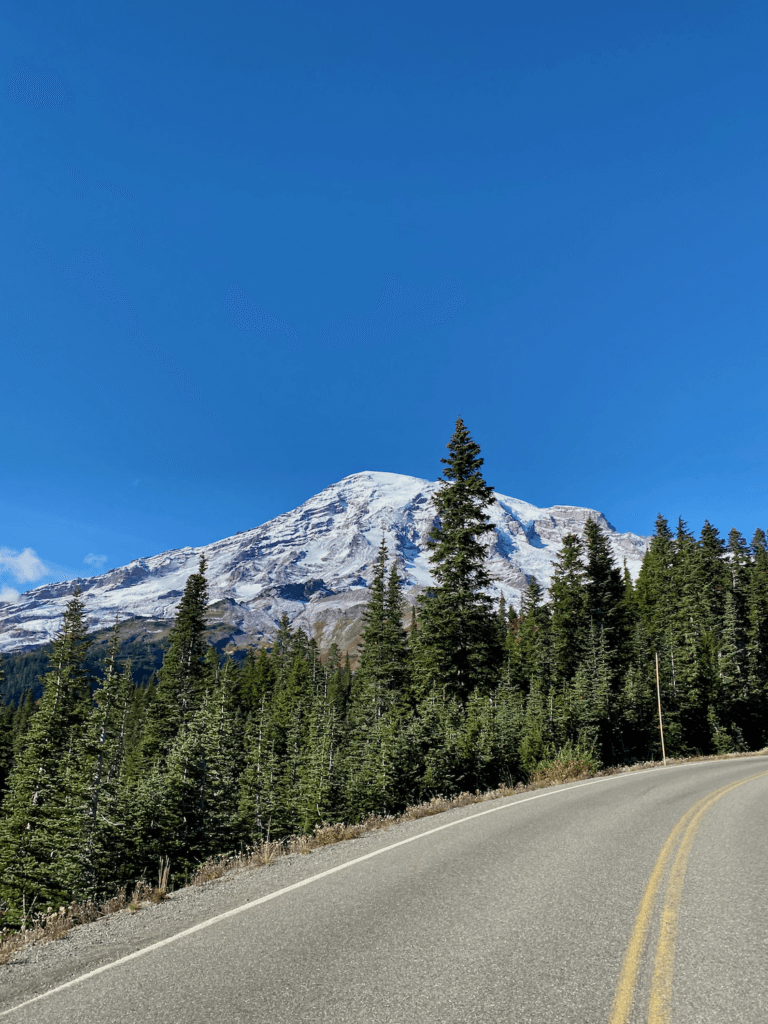
Ideally, I love Mt. Rainier National Park in the fall–September through the first of October. Fewer visitors, no reservations are required after Labor Day, and the colors are stunning. (By the way, I took all the photos in this article in the first week of October.)
What to take on a day trip from Seattle to Mt. Rainier.
Clothing: On a drive from Seattle to Mt. Rainier National Park, you’ll likely encounter several types of weather. Bring layers of clothing, including a sweater and a light rain jacket. At the shoulder times (October through June), the timberline levels can still be freezing, so bundle up and dress accordingly.
Footwear: Waterproof footwear is always advisable for hiking. I see many visitors wearing flip-flops in the summer months, but I advise against this if you want to do any walking on trails. There are a lot of uneven surfaces.
Food & Beverages: There are concessions in Ashford and Packwood leading up to the mountain. Enjoying a beverage on the terraces at Paradise and Sunrise can be lovely — and they have restaurant offerings too. Still, it’s nicer (and less expensive) to bring food and beverage items to enjoy on a picnic table along the way. Remember to leave no trace!
Other: Sunscreen, water, bug spray, sunglasses, snacks, reusable water bottles.
What not to take to Mt. Rainier National Park
Pets are not permitted on any park trails. Drones are prohibited.
Entrance fees to Mt. Rainier National Park.
The fees & passes are similar to most national parks. A standard pass for a seven-day period per vehicle ranges from $15-30. An annual pass for just Mt. Rainier National Park is $55, while the America the Beautiful pass is $80 per year (valid at other agencies like National Forests and Bureau of Land Management).
Passes can be purchased at the entrances, but remember that the park does not accept cash. Also, be prepared for them to match your ID with the name on the America the Beautiful pass.
What is the difference between burnout and remarkable experiences on Mt. Rainier? Connection with Nature’s intelligence.
The difference between a “meh” experience and a memorable one is about grounding with the natural environment. You can probably think back to wonderful travel experiences, and the common denominator would be feelings of belonging—or connection—to yourself, your companions, and the destination.
Whether that is a fun conversation with a server at a quirky restaurant or sighting a rare bird landing on your veranda, magic occurs when you’re open to the beauty of a connection. The wonder awakens your inner self—or your true Nature.
Often, the loudness of modern culture, especially on vacation in an unfamiliar place, adds static—especially that distracting idea that says you need to see it all. Unrealistic expectations prevent a total opening up to the possibilities, consciously or subconsciously. That’s why—without grounding—you might return home feeling like you need a vacation from your vacation.
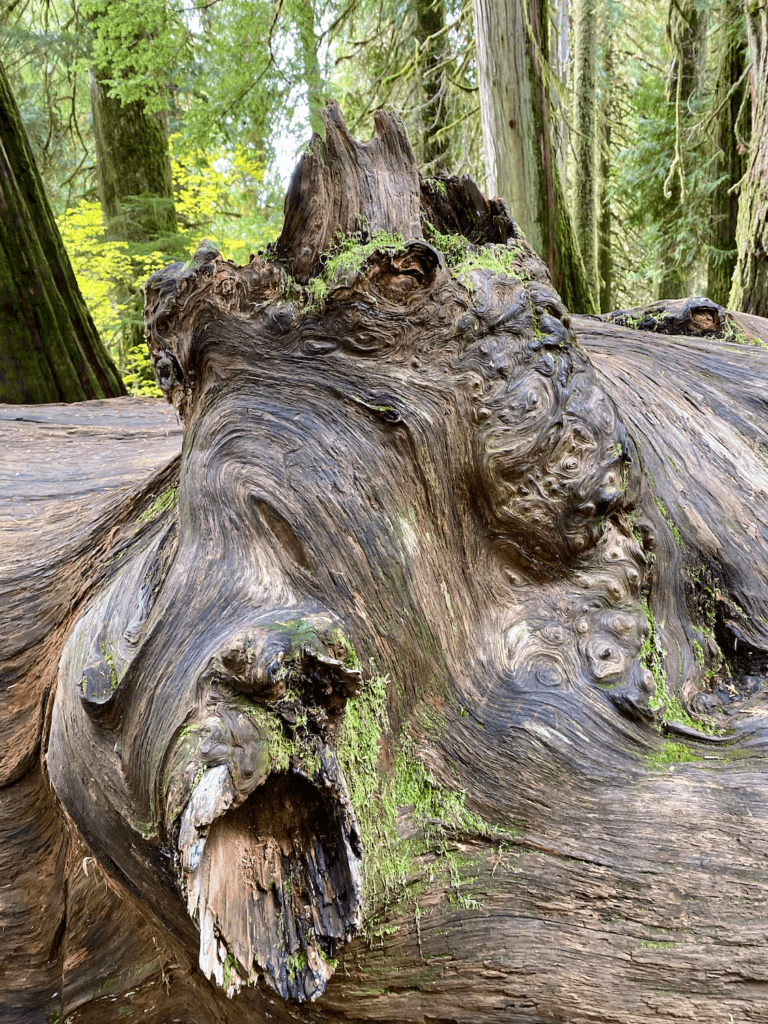
Allowing yourself to focus on grounding in Nature’s intelligence will monumentally change the way you embrace the joy of Mt. Rainier. But don’t worry. You can still enjoy your favorite experiences, like frolicking among wildflowers, gazing at breathtaking views, or running your fingers along the bark of an ancient fir. Consciously deepening your connection to Nature makes all these things more meaningful because you’re more connected to your heart and soul—or your true Nature.
Over the years, I distilled this into six simple questions — the Kinship Questions™ — that help anyone drop into a deeper relationship with the Natural World, in as little as thirty minutes a day. They’re the heart of my book, The Wild Cure, and I walk through them in my article, six questions to deepen your Nature Connection.
This entire article and all my recommendations use this framework to encourage you to take your grounding in Nature seriously while visiting Mount Rainier National Park.
You will enjoy the best possible experience when you spend quality time at a few stops and accept that you cannot see it all in one day.
Are you interested in trying Forest Bathing on Mt. Rainier today?
Wait! This isn’t just new-age jargon. Please read on.
Forest bathing — Shinrin Yoku — began in Japan in the 1980s, when researchers found that slowing down among trees measurably lowered stress and strengthened the immune system. It’s a real, studied practice, and it’s simpler than it sounds. I walk through the science and the how-to in my step-by-step guide, Forest Bathing for Beginners.
Where can you go Forest Bathing on Mt. Rainier?
The answer is anywhere! After all the whole point of this article is to help you slow down to take in all the beauty and magic of this iconic mountain. If you want some pointers, check out my article, “Forest Bathing Near Me — a guide to finding the best places to connect with Nature.”
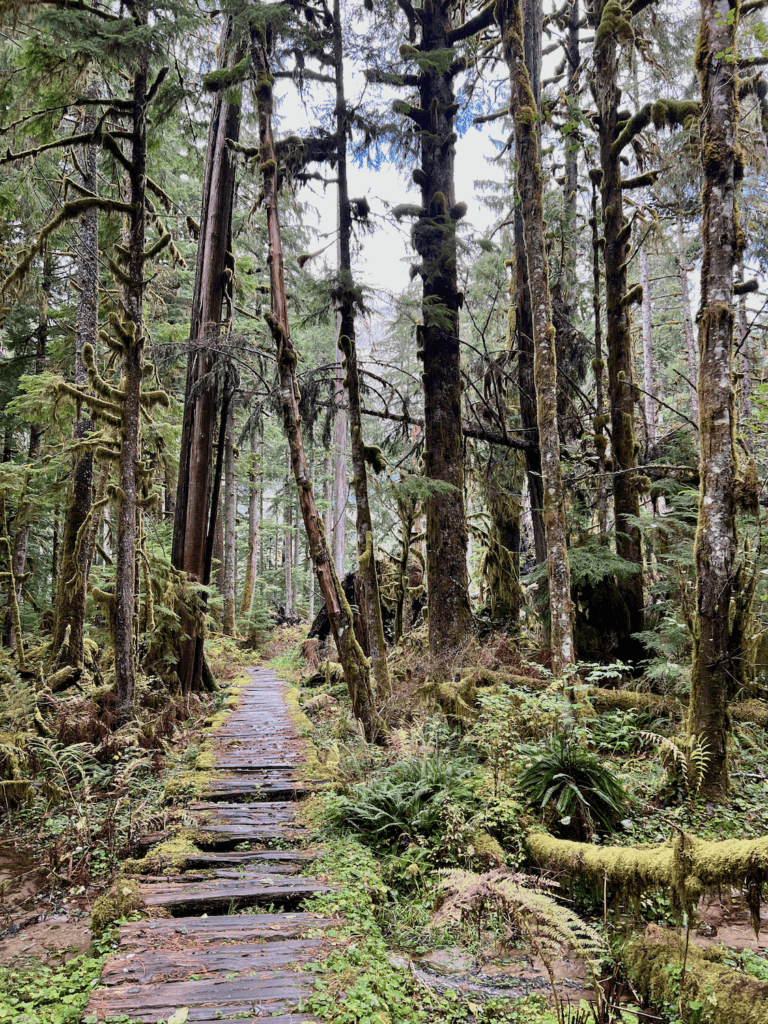
Join me on a YouTube video on Mt. Rainier — a 20 Minute Guided Nature Connection.
How can Nature’s Intelligence help us shine through daily life’s nervous energy ups and downs? This is a path to get out of your head and into your own nature! Quiet your mind, manage emotions for better outcomes, and trust your intuition more by following this guided Nature Connection Experience through a waterfall hike in the secret corner of Mt. Rainier National Park.
For simpler Nature Meditation, also in the rainforest of Mt. Rainier, visit this YouTube video.
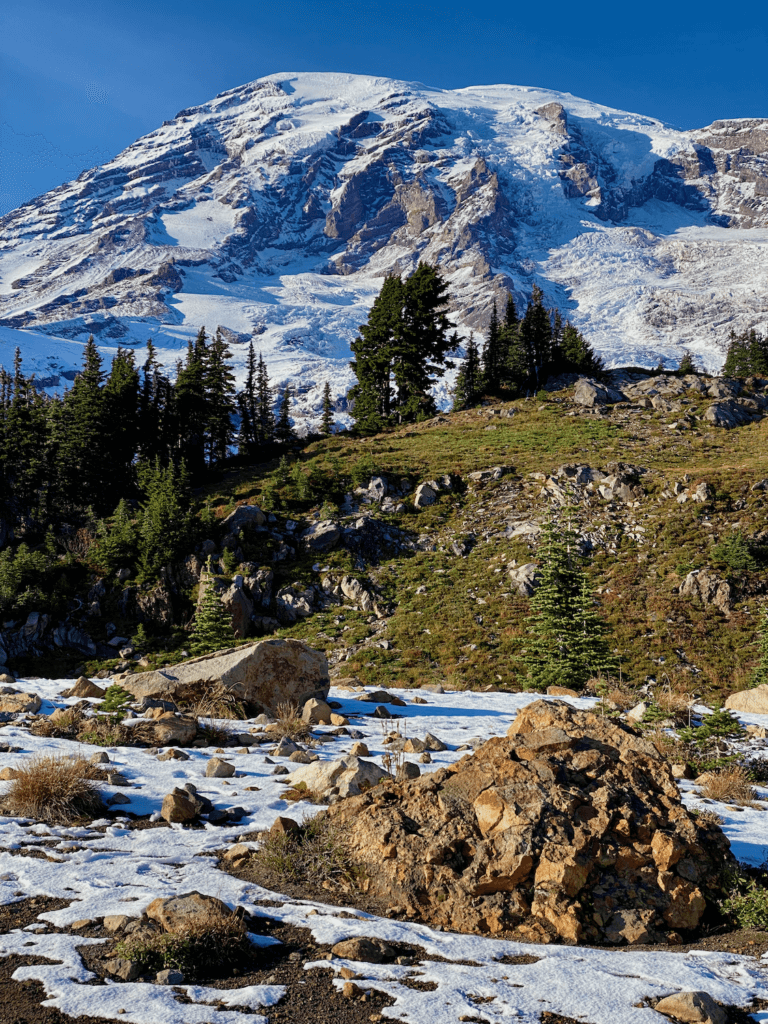
The best trips from Seattle to Mt. Rainier. Yes, opting into a deeper nature connection makes a remarkable difference!
Assuming you can dedicate an entire day to visiting Mt. Rainier, take these steps to plan your nature connection adventure:
- Choose between Paradise or Sunrise. You’ll only have time to adaquately do one. Make it your base of operation for the day. This will also determine your driving course.
- Stop at a viewpoint or visitor center soon after arriving at the park. This helps you establish grounding after driving for a few hours. Longmire Museum and National Park Inn is a good choice from the Nisqually entrance, Ohanapecosh Visitor Center by Stevens Canyon Entrance, and the first pullout on the Mather Memorial Highway en route to Sunrise.
- Be mindful about opting into an authentic nature experience. For more on a framework proven to work, check out six questions to ask yourself for a deeper connection with nature.
- Dedicate at least twenty minutes (or longer) to every stop. This is how long it takes to make an authentic nature connection. Keeping mindful of slowing down will help set your “natural” pace — where the remarkable memories are made.
- Commit to limiting distractions by jumping out and in along the way. I know this is hard with all the views, but after a few stops, all the waterfalls and viewpoints will seem the same. Then, your remarkable experience begins to diminish.
- Only go for a short time without eating. Nothing crashes a nature experience like a hanger.
- If appropriate for your travel party, select one trail for a hike. One longer hike will reap more benefits than a bunch of short sprints. I like to use AllTrails to look into possible options beforehand. They have a handy app version, too.
- Remember, there will not be reliable cell service anywhere in the park.
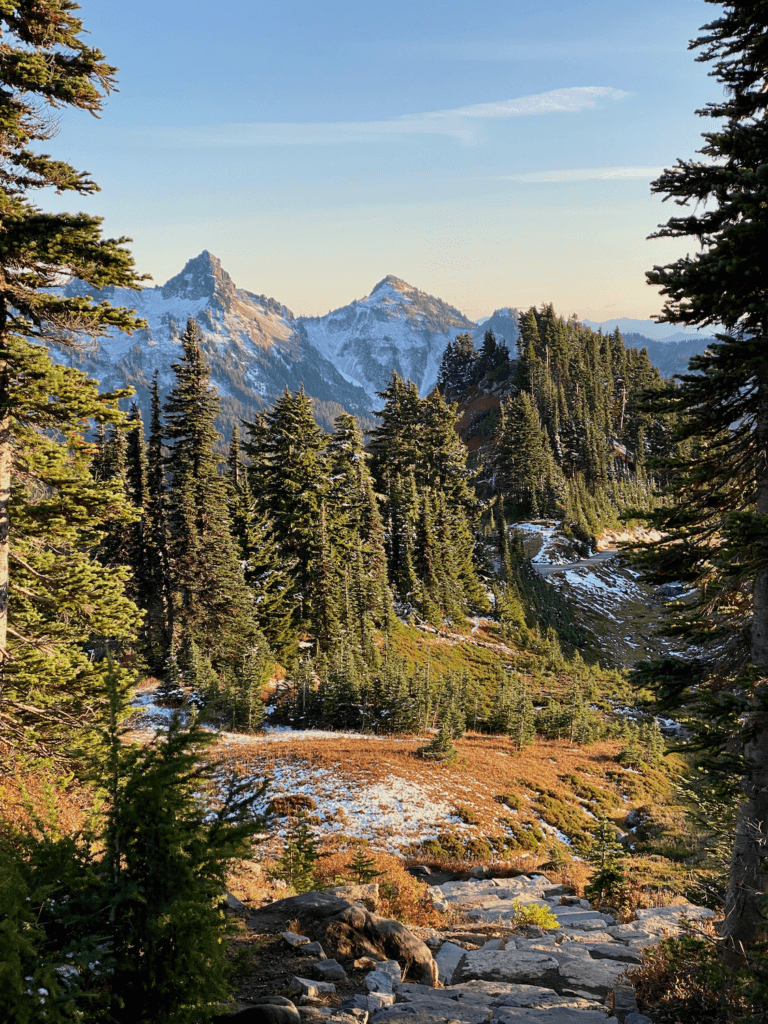
Witness the soul of Mt. Rainier’s alpenglow.
Consider the glow of dawn and dusk and plan accordingly. The light at these times of day offers a magical filter, casting exciting shadows that undescribably transform the landscape. It is also a better option for photos compared to what can sometimes be harsh midday light.
Nisqually Entrance and Longmire Museum
The picturesque Nisqually Entrance is the busiest gateway to Mt. Rainier National Park, and for good reason. The 17.7-mile winding road to Paradise quickly gains elevation and spectacular views over about 35 minutes.
Ashford, Washington, is the out-of-park gateway to this area. It offers various food and lodging options, including one of my Airbnb favorites, Fernhaus. It makes a great base for a few days’ worth of exploring the mountain, especially because you can easily enter the park before 7 am and lets you get an early start before the day-trip crowds arrive.
This is also the place for ambitious mountaineers to find an outfitter to summit the highest point in Washington State—at 14,411 ft. I made a successful trek to the top of Mt. Rainier in 2011 using the guide services of R.M.I. Expeditions and would highly recommend them.
Once inside the park, the Longmire Museum area is a great stop to stretch your legs (if you’re doing a day trip from Seattle). The Rampart Ridge Trail or Trail of the Shadows are great options to get acquainted with the mountain energy. The Longmire General Store, adjacent to the National Park Inn (see below), sells gifts and basic groceries. It is the only in-park service that is generally open year-round.
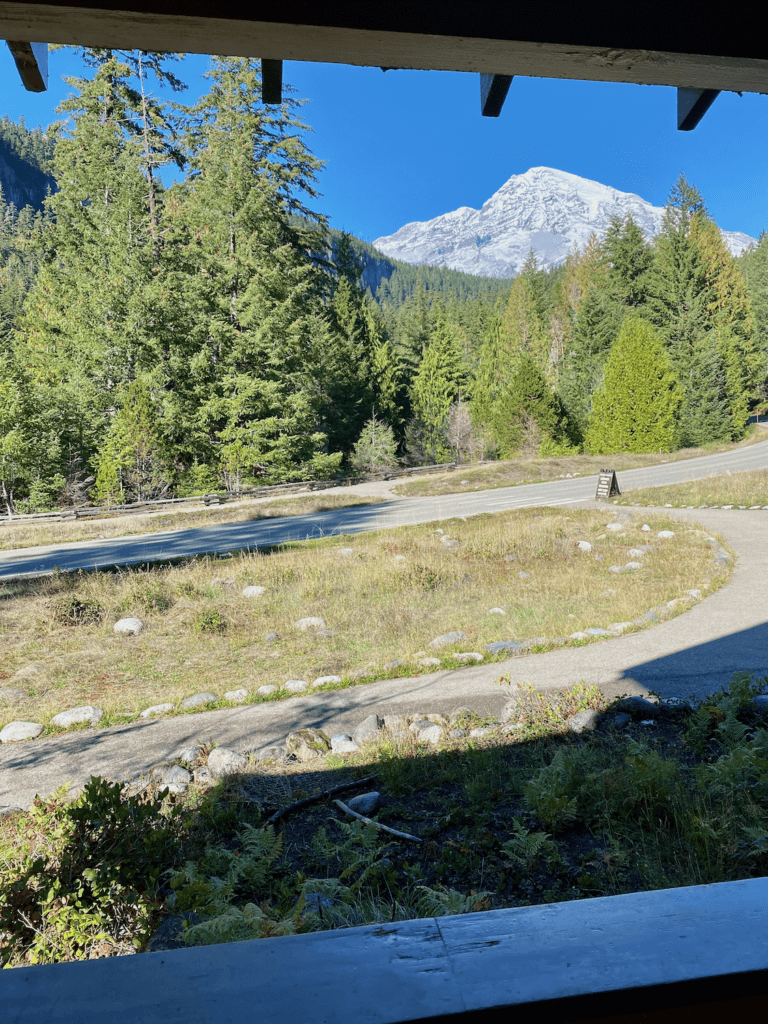
A significant benefit of staying here is the ability to quickly and easily access all the beauty of Mt. Rainier National Park before everyone else arrives for their day trip from Seattle and other locations. Staying inside the park means you’re on the mountain before everyone else arrives.
It’s lovely to relax in a rocking chair on the front porch after hiking and watching waterfalls while gazing at the Queen volcano. The accommodations are basic but comfy enough.
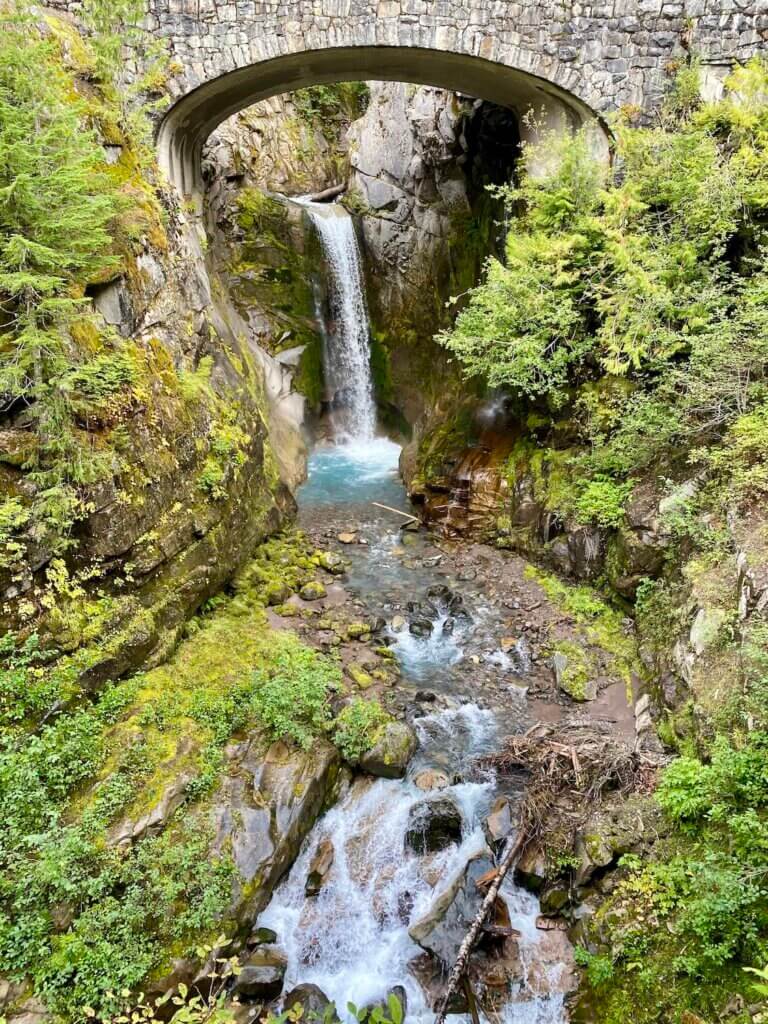
Seattle to Mt. Rainier waterfalls and viewpoints en route to Paradise
I suggest enjoying this stunning drive and selecting only one viewpoint and waterfall. Here are my top suggestions.
- Cougar Rock is an expansive campground and ranger station, as well as a great trailhead for hikes on the Wonderland and Carter Falls Trails.
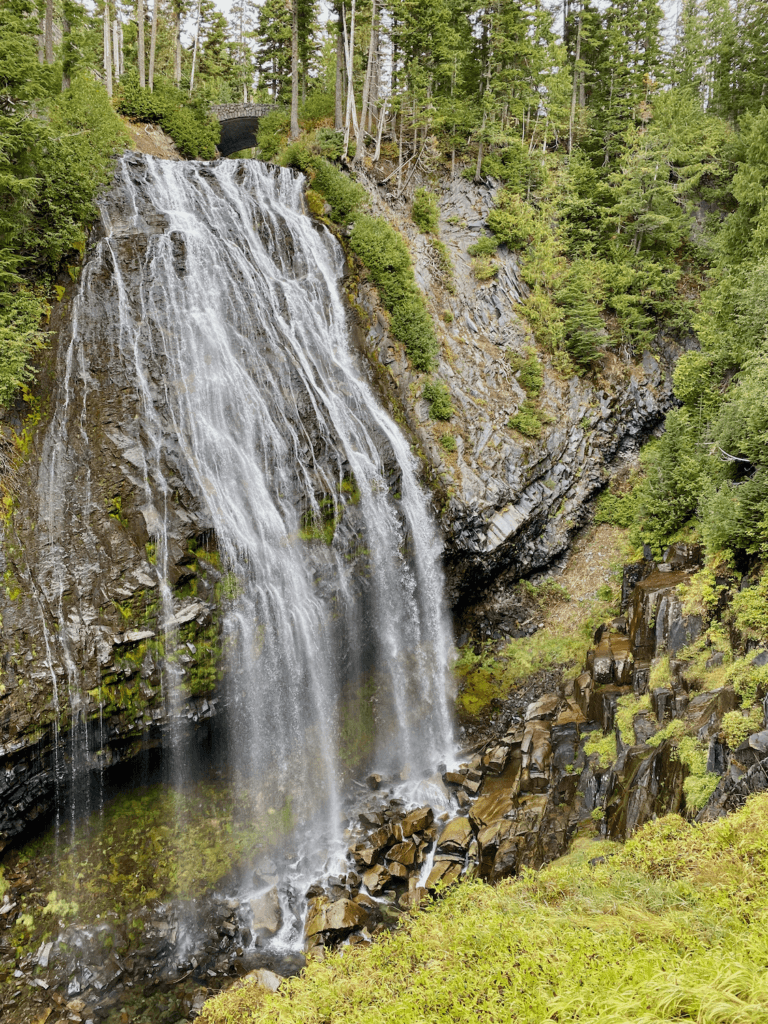
- Christine Falls: A very short hike down to a viewpoint of a charming waterfall flowing beneath the roadway (photo shown).
- Rickseker Point: This is the most accessible place to pull off the road because it is a one-way outer loop with expansive views.
- Narada Falls: This is my favorite waterfall because you can learn about the difference between the volcanic lava of Mt. Rainier butting up with the Tattoosh Mountains — formed from plate tectonics.
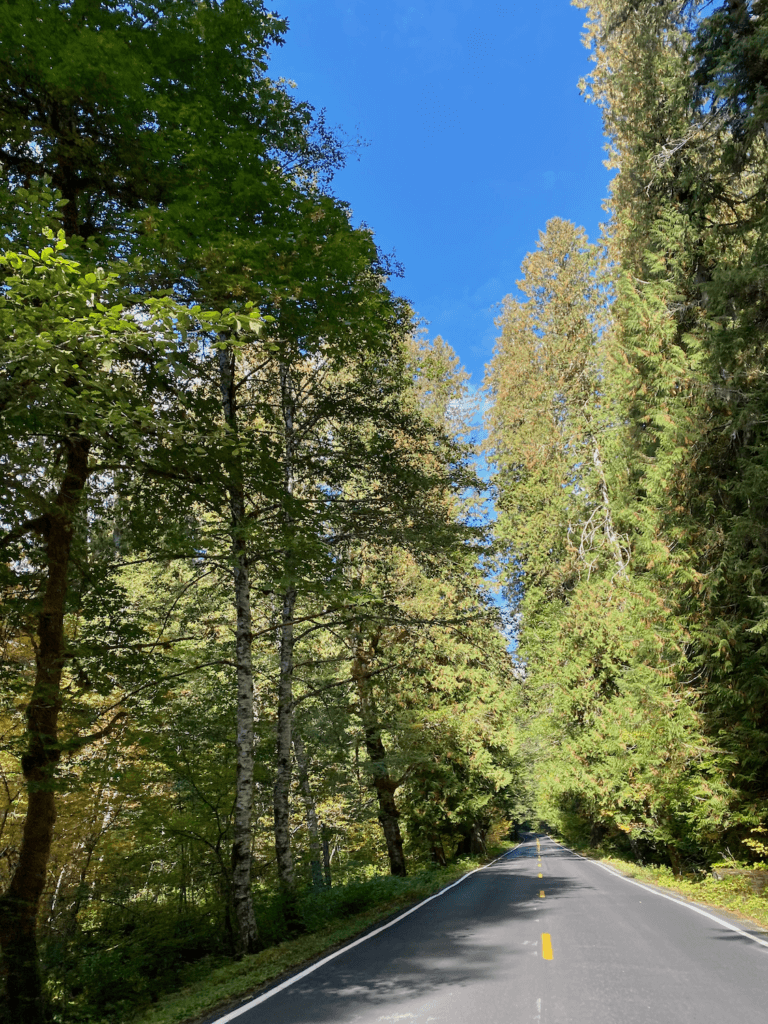
Carsick much?
This road is beautiful but very windy. Take precautions if you’re traveling with people prone to carsickness. In general, the passenger side of the vehicle will have the best views on this portion of the road.
Paradise — the jewel of Mt. Rainier
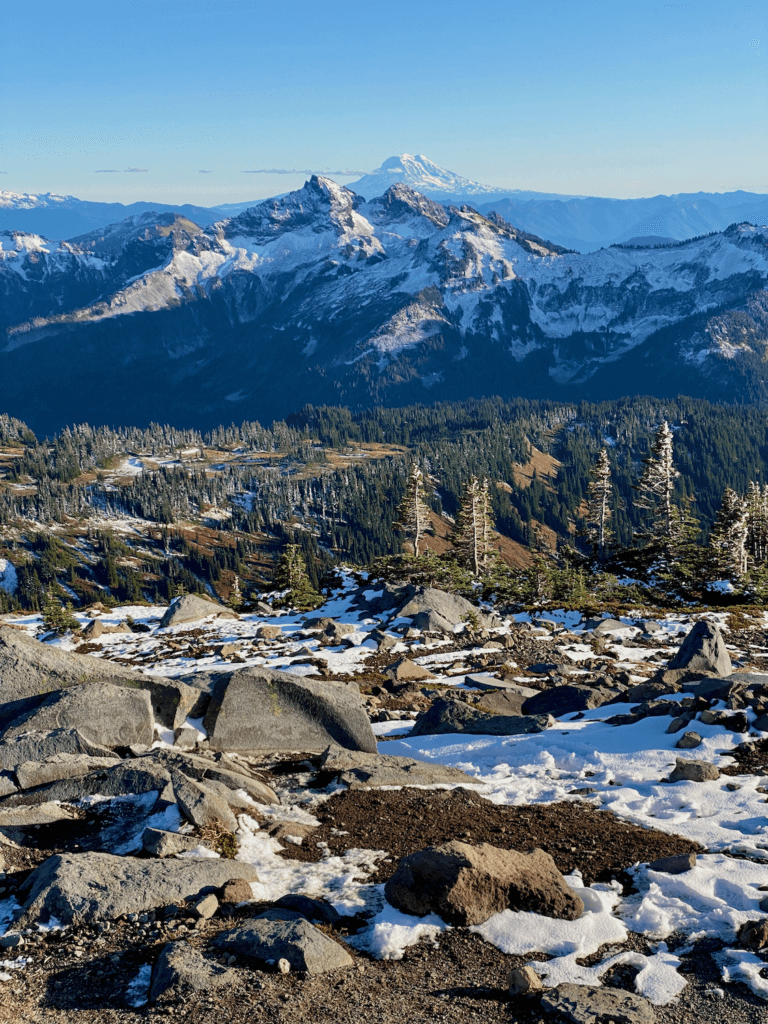
There isn’t much more to say than Wow! It’s rare to be able to drive up a well-maintained paved roadway to a mile-high perch. The timberline hovers above the clouds as a geological hem between the volcanic magic of Mt. Rainier and the dramatic Tatoosh Range (photo shown with Mt. Adams in the distance) — a plate tectonic phenomenon.
Please don’t consider this an up-and-back photo opportunity. She deserves respect and your full attention. Take time to explore the fascinating Henry M. Jackson Memorial Visitor Center. Find a peaceful place to enjoy a meal with loved ones in the broad picnic area. This is a place to savor the wonder of Nature’s Intelligence. Here are tips—proven to work—for how to do this in a way that reaps remarkable results.
If you’re intereseted in exploring the many trails in this area, check out a sister article I wrote about enjoying Paradise. Beautiful wildflowers abound in July and August, leading to wondrous fall hues with random snow sprinkles. (By the way, I took all the photos in this article on Mt. Rainier in October.)
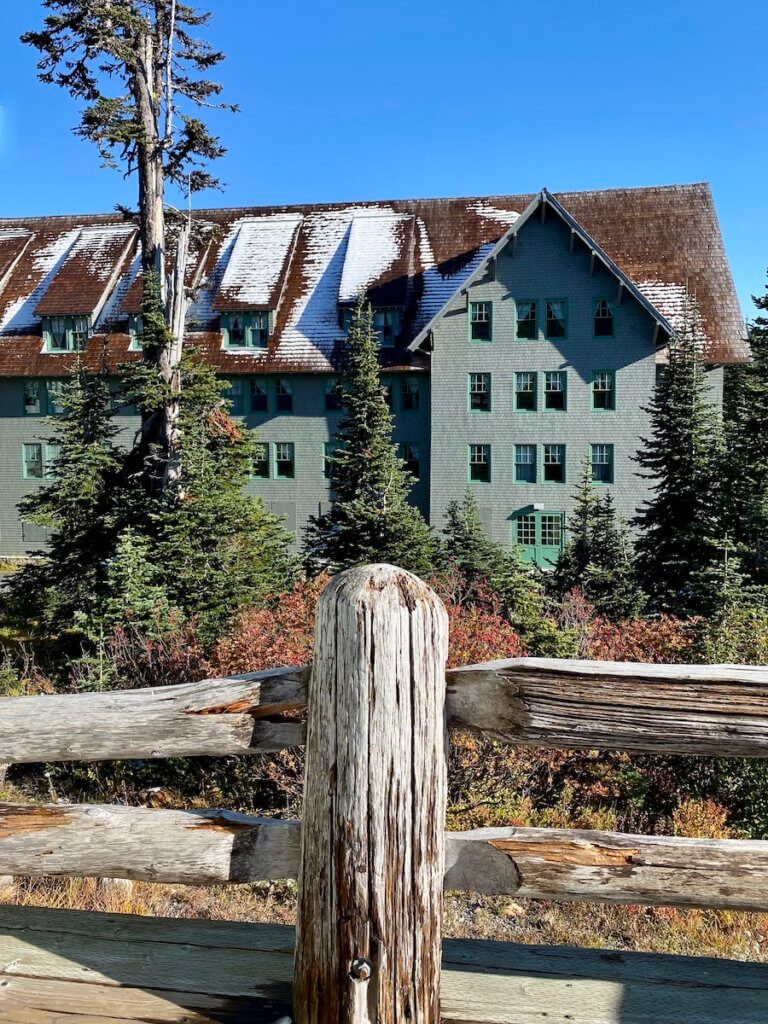
It can be hard to get a reservation here, but when you do — be prepared for a remarkable mountain experience. Go to bed under the bright stars and wake up to the freshest alpine air with hints of fir.
This historic lodge is only open during a short window between June & September. Also, it provides concessions like sit-down meals and grab-n-go options. Sitting on the porch enjoying a beverage with 360-degree natural beauty is hard to beat.
Mt. Rainier lakes and waterfalls to Ohanapecosh Visitor Center
Continuing from Paradise towards the Stevens Canyon Entrance provides a thrilling mixture of dramatic roadside vistas and idyllic lakes reflecting the mountain. The pullouts are mainly on the right-hand side of the roadway, making an eastward drive easier.
Select a lake to stop and spend time. Enjoy at least twenty minutes in a stillness to take in the mountain energy. If you want to hike a little, the track to Bench and Snow Lakes is a great option.
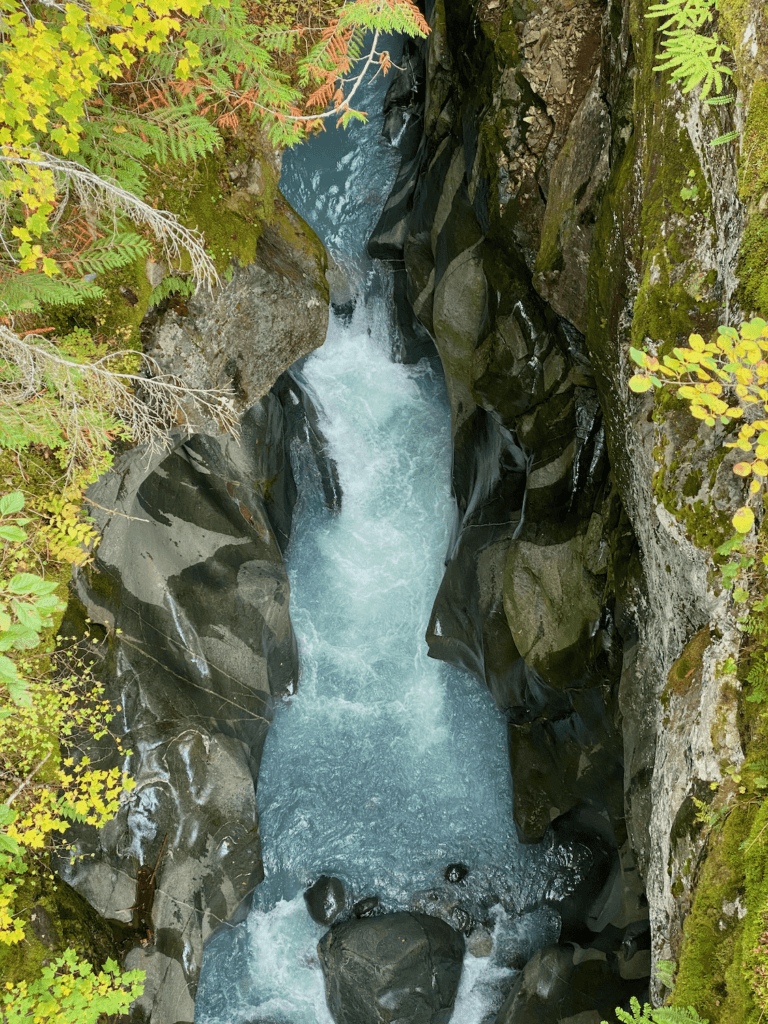
Further down the road, there are a few waterfall viewing areas. I find Box Canyon (photo shown) fascinating and different for a water feature. Take the short trail through informative placards about this area’s geological wonder and peer down 115 feet to the churning Cowlitz River–which makes its way to the Columbia River in Longview, Washington.
As mentioned above, the alcove of thick and ancient forest around the Stevens Canyon Entrance is a quality choice to spend some time. While the Grove of the Patriarchs Trail is closed from the suspension bridge (until estimated 2028), there are many other ways to wander under the canopy of wise Douglas fir, cedar, and hemlock.
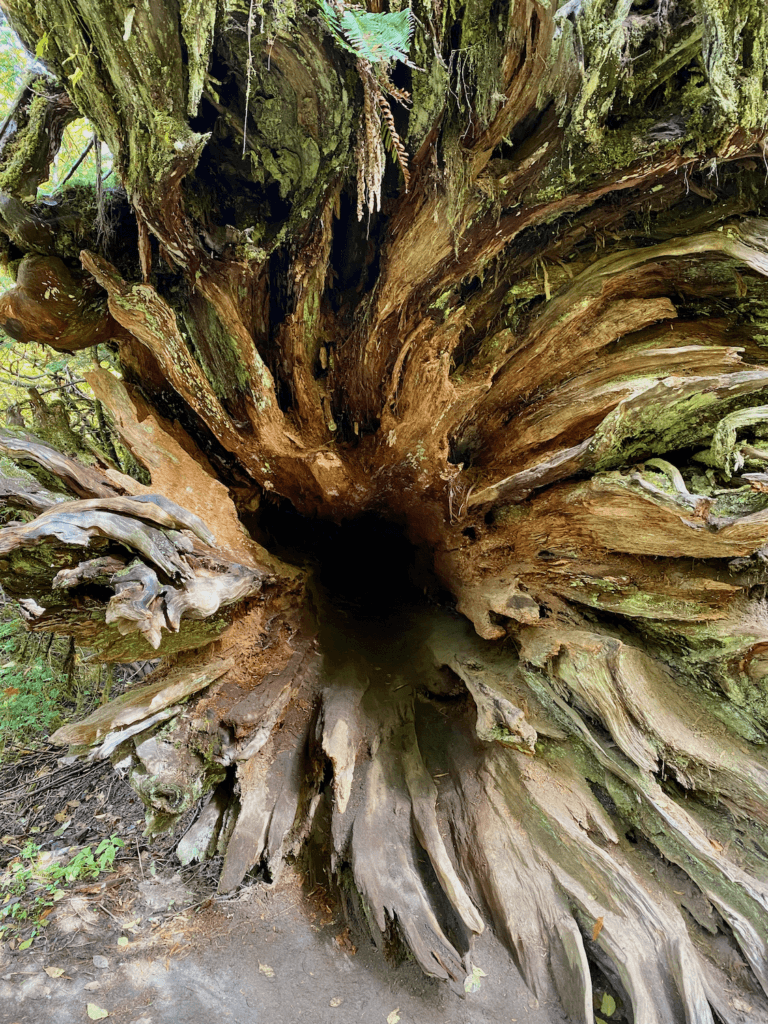
Waterfall and old-growth hiking: Ohanapacosh & Silver Falls.
The park’s southern end holds thriving pockets of old growth amidst bubbling creeks, waterfalls, and soul-nourishing fresh air. While there aren’t views of the mountain peak, it’s a special place to go slow and deepen your nature connection.
An outstanding 2.9-mile hike option is a loop that begins around the Ohanapacosh Visitor Center — heading up and back to Silver Falls (or vice versa depending on parking).
Sunrise Visitor Center — Exhilarating views of Mt. Rainier
Where Paradise offers a modern visitor center and an overnight lodge with plenty of concessions, the experience at Sunrise feels more rugged and local. At 6,400 ft altitude, it is the higher, generally drier, and more sunny option. This location is also closer to Seattle, which can make it more popular with hiking regulars.
When embarking on a day trip from Seattle to Mt. Rainier, it is too much to try to see both Paradise and Sunrise — without rushing. Select one and commit to experiencing the remarkable beauty there.
Please don’t consider this a “quick” photo opportunity. She deserves respect and your full attention. Take time to slowly explore the wildflowers and views. Find a peaceful place to enjoy a meal with loved ones. This is a place to savor the wonder of Nature’s Intelligence. Here are tips—proven to work—for how to do this in a way that reaps remarkable results.
The Sunrise Visitor Center is open July through September and offers basic grab-n-go food and beverage options. But that’s not why you’ll want to go here.
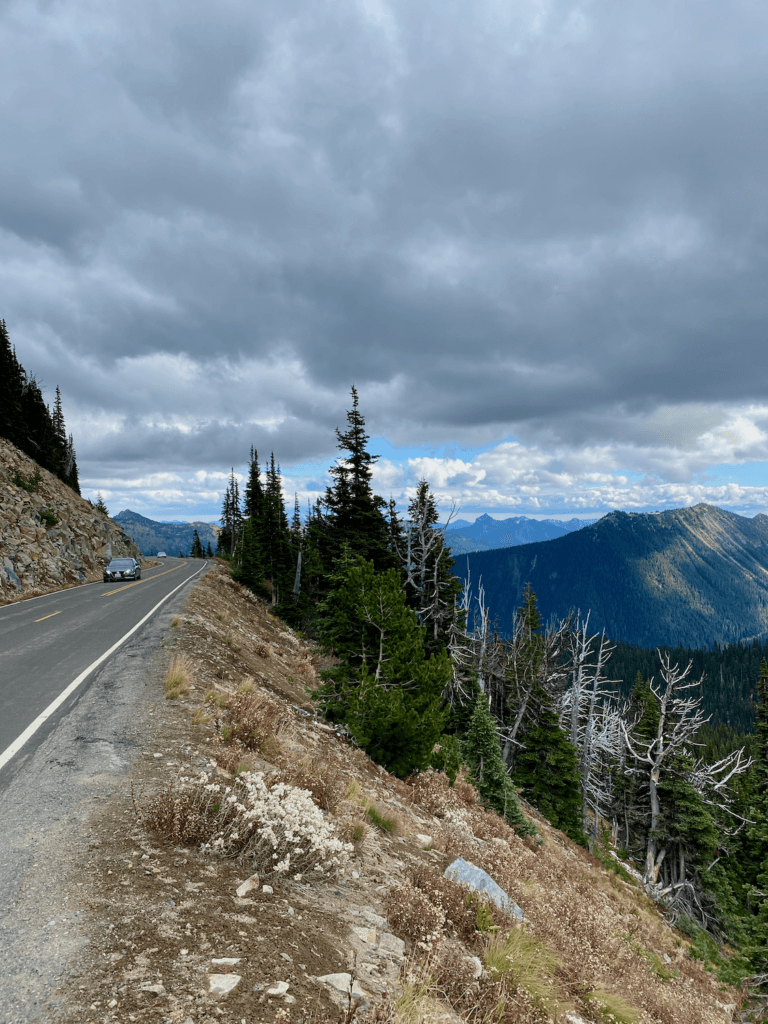
Backup option: Chinook Pass & Tipsoo Lake
It’s a lovely stop if you have extra time, though with a single day from Seattle it isn’t essential. The east entrance to Mt. Rainier National Park is a fantastic option for witnessing the wonder of lakes lined with wildflowers against the backdrop of Washington State’s most impressive volcano. This is a beautiful, easy (and popular) trail.
Break from the status quo.
There’s more to your nature.
Let me help you find it.
Travel the Pacific Northwest with purpose and meaning.
A lifetime of wandering about Oregon and Washington State gives me powerful practical wisdom to share about travel. And you receive the bonus of my unique mystic connection to the land. I can show you how and where to deepen in nature. This is perfect for:
- First time visitors to the Pacific Northwest.
- Locals hosting out-of-town visitors.
- Those wanting to experience travel + nature + spirit in new ways.
Walk with me — in person, near Seattle.
If Rainier stirred something in you, bring it closer to home. My guided forest bathing walk is a slow, unhurried few hours in the Natural World — a chance to practice the Kinship Questions with me beside you, then carry the calm back into your everyday life.